



11 Sep Family Constellations and Money: The Patterns You Inherited
Most of us treat money as a practical matter. Budgets, salaries, decisions, discipline. Then you notice you have made the same decision five times in ten years, and that it never really felt like a decision at all.
You get close to earning more and something goes wrong. You undercharge and cannot say why. You are careful with money to the point of discomfort, or you cannot hold on to any of it. You finally get the promotion and feel oddly flat about it.
These are the patterns that bring people to family constellation therapy with a question about work or money. They almost never turn out to be about money.
The money story you did not choose
Long before you had an opinion about money, you were watching. You saw who worried about it and who went quiet when it came up. You saw who was admired for what they earned, and who was not spoken about at all.
Researchers call this family financial socialisation, and it is reasonably well evidenced. Children absorb attitudes, norms and behaviours around money from their family long before any formal financial education, and those early messages track into financial wellbeing in adulthood. Much of it is picked up without anyone sitting down to teach it.
Constellation work starts in a similar place and then goes one step further. It asks not only what you learned, but what happened in the system, and who is still carrying it.
What actually shows up in a constellation
In a session you set up your family system using representatives, people standing in for your parents, grandparents, siblings, sometimes for the business or for money itself. Then everyone stops talking and we watch.
What surfaces is rarely a lesson about budgeting. It is usually a place where something between the generations got interrupted. A bankruptcy nobody discusses. A business taken from someone, or taken from someone else. An inheritance divided in a way that was never spoken about again. A relative who lost everything and quietly stopped being mentioned. A migration where a whole life was left behind and started again from nothing.
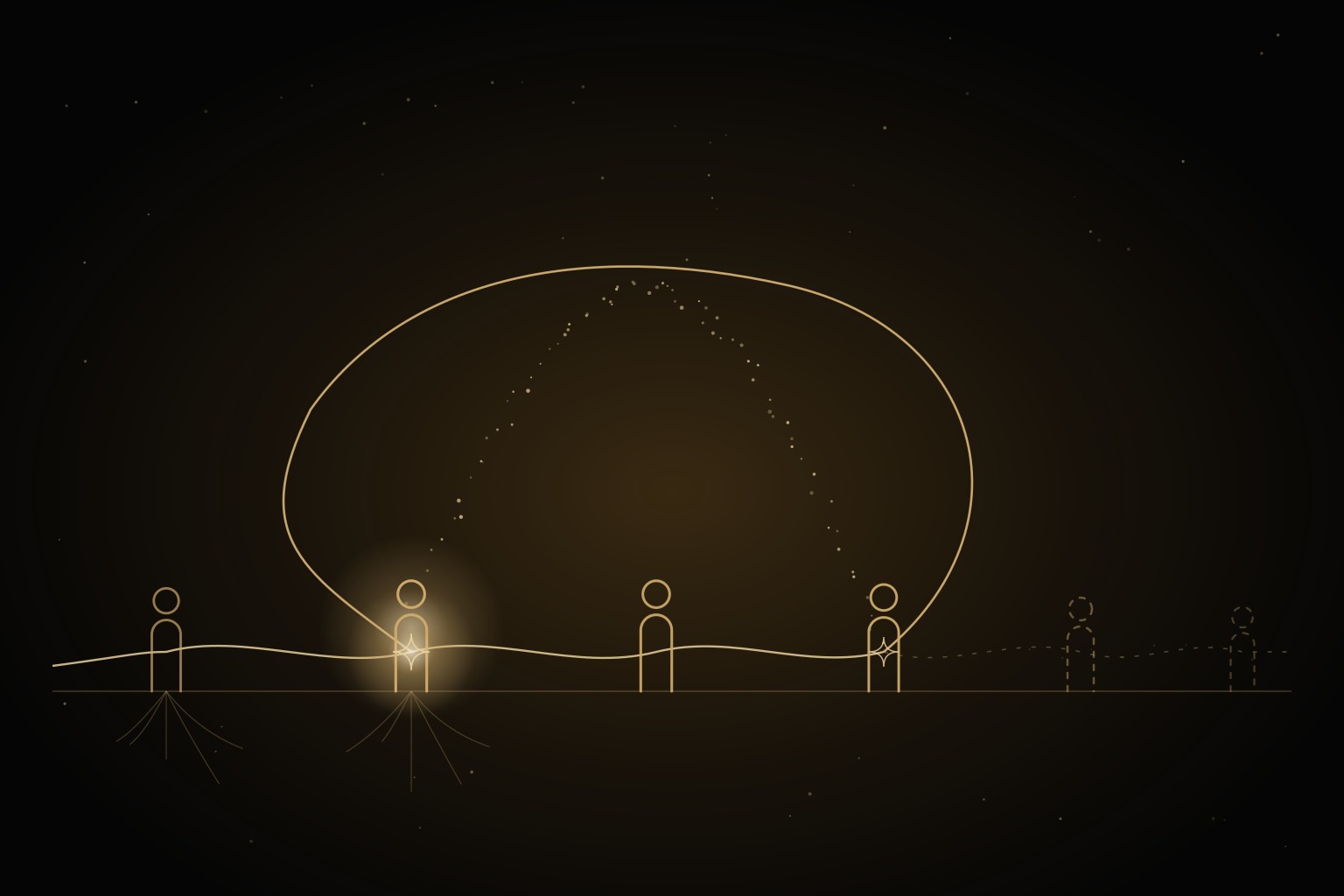
The interesting part is what the representatives report. Someone standing in for a grandfather will often say they feel heavy, or that they cannot look forward, only back. Someone standing in for the client will say they cannot move, or that they keep wanting to turn round. Nobody has been told the family history. It still comes out.
Learning to notice where the flow stops, and to resist steering it toward a tidy answer, is most of the skill. It is a large part of what our family constellation facilitator training works on over three years, because the temptation to fix something too early is very strong and it usually closes the picture down.
Why doing well can feel like a betrayal
Family systems pull toward belonging. If your father worked all his life and never got out from under it, then earning three times what he earned can feel, somewhere well below language, like walking away from him.
Nobody decides this. It arrives as a business that stalls just short of working, a price you cannot bring yourself to say out loud, a good opportunity you talk yourself out of on a Tuesday afternoon for reasons that sound sensible at the time.
In a constellation the movement is often very plain. You look at the person and you say something like, I see what it cost you. I will take what you gave me, and I will make something good with it. It is not clever. It is not a reframe. But said to the right person in the right place, it can change the whole picture in the room.
Four patterns that come up again and again
Exclusion. Someone lost money, or was blamed for losing it, and slowly stopped being talked about. What gets excluded from a family tends to come back through someone later, often the person who never knew the story.
Imbalance. One side of the family gave far more than it received, or took far more than it gave. Descendants can end up trying to settle an account that was never theirs.
Difficulty receiving. People who could not fully take from their parents, for whatever reason, often find it hard to take anything. Money is simply where it becomes visible and measurable.
A career that belongs to someone else. Sometimes the work you do is not really yours. It is an unfinished life being finished on your time.
What the evidence does and does not say
It is worth being straight about this. A systematic review of family constellation therapy found a moderate effect on general psychological distress, but the reviewers were clear that the number of studies is small, the methodological quality is low, and a minority of participants in some studies reported negative effects. Nothing in that literature looks specifically at money or career outcomes.
So this is not financial advice, and it is not a replacement for therapy where a diagnosed condition is involved. What constellation work offers is a way of looking at a pattern from outside it, which is often exactly what a stuck pattern needs.
Where to start
Start with the sentence. Whatever you find yourself saying about money, in your own voice, at the moment things tighten. Money is not safe. There is never enough. It is not for people like us. People like us do not ask for more.
Then ask a much better question than whether it is true. Ask who said it first.
If you want to work with this in a group, our Discover Your Money Success workshop is built around exactly these patterns. If you would rather look at your own system privately first, you can book a one-to-one session and we will start wherever you are.
Sorry, the comment form is closed at this time.